A-Io–Benbili relationship
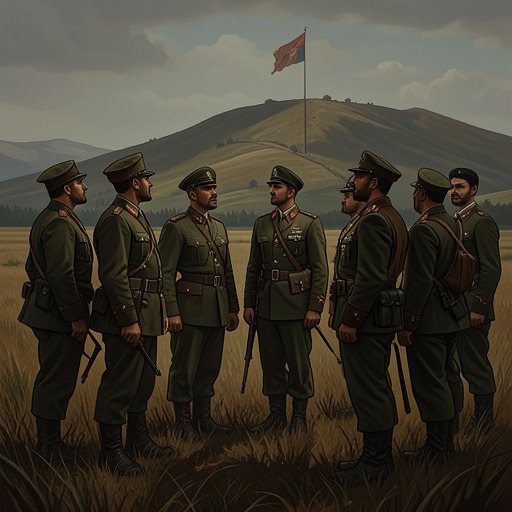
The DispossessedA-Io’s relationship with Benbili becomes most visible when revolution overturns the country’s military dictatorship and A-Io answers by sending troops under the stated purpose of supporting democracy. The intervention makes Benbili a proxy battleground in A-Io’s rivalry with Thu, while the contrast between unarmed revolutionaries and modern military force gives Shevek a concrete view of how claims of order can mask domination.
Background and Strategic Context
Benbili is described as a large, poor, underpopulated country of mountains and arid savannahs, formally a parliamentary democracy but in practice governed by generals. News reports announce that revolutionaries have taken the capital, Meskti, and that the president has fled. The rebellion opens the jails and grants amnesty to prisoners; as the retreating army burns towns and fields, guerrilla partisans harry it. The upheaval is not presented as a settled democratic transition but as a struggle whose outcome remains uncertain.
The wider political contest quickly becomes explicit. Thu still holds two eastern provinces, and A-Io and Thu are expected to fight over Benbili rather than invade one another directly. An Ioti ambassador announces that A-Io is sending armed reinforcements to the government of President-General Havevert, who has already escaped in his armored airplane. A-Io’s stated defense of democracy thus supports the incumbent general even as the revolutionaries have taken the capital and are resisting the retreating army. The intervention is framed in the language of restoring legitimate government, but its immediate effect is to bring a powerful foreign army into a domestic revolt.
The Intervention and Its Unequal Force
The means of intervention make the imbalance unmistakable to Shevek. The Benbili revolutionaries are mostly unarmed; A-Io’s forces arrive equipped with guns, armored cars, aircraft, and bombs. Reading about this arsenal makes Shevek physically sick. His reaction registers the distance between a diplomatic justification and the material reality facing the rebels: the revolutionaries’ hope of freedom is exposed to overwhelming force supplied by a rival state.
A-Io’s action is also presented as part of a balance of power between states. An Ioti explains that neither side would sensibly invade the other’s territory, describing intervention in Benbili as the kind of police action that preserves that balance. At the same time, he acknowledges that the countries are officially at war. The language of avoiding older forms of warfare therefore coexists with a military campaign on Benbili’s soil. What is represented as a controlled alternative to war still subjects Benbili to the contest between A-Io and Thu.
Shevek’s Response and the Crisis of Silence
The revolution changes how Shevek understands his position on Urras. He follows the reports with growing intensity, moved by the opening of the prisons and the possibility that the rebellion might succeed. The news that A-Io will intervene turns that hope into revulsion. He cannot discuss the matter freely with the people around him: Saio Pae is unavailable to him, Atro is a committed militarist, and Demaere Oiie’s concern for property and order makes him defend the intervention as political realism. Oiie argues that Benbili’s rebels are learning that freedom cannot endure without weapons to defend it.
Shevek rejects the equivalence between state force and the impersonal forces of nature. He condemns Oiie for placing laws protecting wealth and the guns and bombs enforcing them in the same frame as entropy and gravity. The exchange silences Oiie, but it does not dissolve the political gulf between them. Instead, the Benbili crisis sharpens what the novel identifies as Shevek’s problem of silence: he has trusted those around him through a lifelong habit of solidarity, yet the events make that trust difficult to sustain. Chifoilisk’s warnings return to him, and Shevek concludes that he must learn distrust, remain silent, and keep his intellectual work as bargaining power.
War, Restrictions, and Political Meaning
The war’s consequences reach beyond Benbili. Under wartime rules at the university, research may be classified, publication delayed by government approval, and non-nationals such as Shevek restricted from leaving campus without the Chancellor’s clearance. Atro treats these controls as minor inconveniences and offers to get around them. The episode shows how a declared state of war expands governmental authority into research, publication, and movement, even when the war is fought elsewhere and the restrictions are described as routine.
The intervention also gives the relationship between A-Io and Benbili a sharp contrast with Anarres’s political ideals. Shevek’s home society depends on mutual aid and collective coordination, though it too recognizes the dangers of centralization and informal control. In Benbili, by contrast, the language of protecting democracy accompanies the arrival of armed state power. A-Io’s professed political purpose and its military means pull in opposite directions; the resulting contradiction is part of what makes the distant revolution consequential to Shevek’s developing understanding of Urras.
The novel later places that contradiction beside the public violence of A-Io itself. At Capitol Square, police helicopters fire on demonstrators, and soldiers enter the Directorate through a crowd pressed against its doors. The blood-written word “DOWN” gives the uprising’s opposition a visible mark inside the state’s own seat of power. This scene does not make the Benbili conflict identical to the domestic crackdown, but it intensifies the earlier contrast: A-Io claims to support democratic government abroad while its own authorities answer public protest with armed force at home.
Borders and the Limits of Contact
The political stakes of A-Io’s intervention are also bound up with the isolation of Anarres. In a debate over whether a small group of Urrasti should be invited to Anarres, Rulag warns that limited contact could lead to profiteers, armed ships, and renewed domination. Her argument treats the settlement’s closure terms as a defense against the kind of unequal power that Benbili is experiencing: a stronger outside force can turn contact into exposure and intervention.
The restriction is explicit: no one arriving from Urras may leave the freight ships beyond the boundary of the Port of Anarres. Shevek’s entry into the Terran embassy on Urras, meanwhile, is possible because the embassy is treated as Terran soil, a diplomatic fiction that lets him claim protection from A-Io. Together these boundaries show the uneven ways political power controls access: A-Io can project military power into Benbili, while the settlement’s rules seek to prevent comparable entry onto Anarres. Benbili’s revolution therefore matters not only as a contest between A-Io and Thu, but as a demonstration of what happens when a weaker society’s political future becomes an arena for stronger states.